
5 Integration Patterns for Adding Vitals Data to Policy Admin Systems
An insurance-technology analysis of five integration patterns for moving vitals data into policy admin systems without slowing underwriting, audit, or downstream operations.
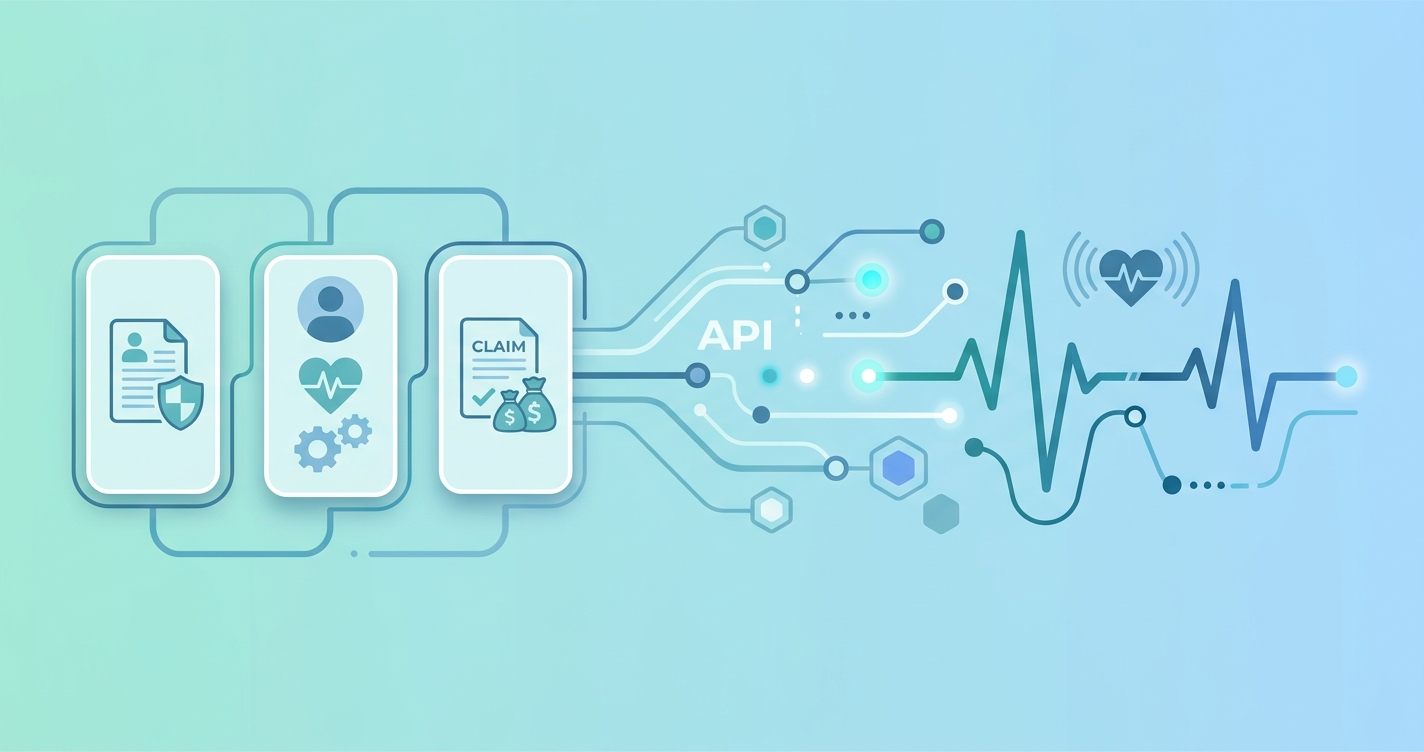
Policy administration teams keep running into the same problem: underwriting wants richer health data, but policy admin systems were not designed to ingest camera-based vitals, screening metadata, and confidence signals in real time. That tension matters now because modern insurance distribution has less patience for manual rekeying and batch delays. For digital underwriting platforms, vitals data only creates value if it can move cleanly into the systems that issue, amend, service, and renew policies.
"ACORD's Next-Generation Digital Standards are designed to support data transfer mechanisms including microservices and RESTful APIs." — Bill Pieroni, ACORD, announcing the 2020 release of the organization's Next-Generation Digital Standards
Integration patterns for vitals data in policy admin systems
There is no single best pattern for every carrier or platform. The right choice depends on when the data is needed, how much of it must persist in the policy record, and whether downstream teams need the raw observation, a derived risk signal, or both.
Still, five patterns show up again and again in real insurance architecture work.
| Integration pattern | Best fit | What enters the policy admin system | Main advantage | Main tradeoff | |---|---|---|---|---| | Synchronous API write-through | Quote or bind flows that need an immediate underwriting decision | Normalized vitals summary plus decision payload | Fast underwriting orchestration | Tight coupling to PAS uptime and latency | | Event-driven handoff | New business flows with multiple downstream consumers | Vitals event, identifiers, and status updates | Looser coupling and better scalability | More reconciliation work | | Canonical data hub | Multi-carrier or multi-product platforms | Standardized health screening object mapped for each downstream system | Cleaner reuse across systems | Higher upfront data-modeling effort | | Document-plus-metadata ingestion | Legacy PAS environments | Key vitals fields plus attached screening artifact | Easier retrofit into older systems | Limited searchability if overused | | Rules-engine sidecar | Platforms that separate scoring from core policy admin | Derived risk signal, flags, and explainability notes | Keeps PAS lean while supporting automation | Requires strong governance between systems |
1. Synchronous API write-through
This is the cleanest pattern when policy admin is part of the quote-time transaction. A vitals capture service returns normalized observations, the underwriting layer evaluates them, and the platform writes a compact payload into the policy admin system before the applicant moves to the next step.
For digital platforms, the appeal is obvious. Everything stays in one request path, and the servicing system receives the same applicant state that underwriting used. But this pattern only works if the payload is disciplined.
Teams usually do best when they store:
- the observation timestamp
- the measurement type and units
- a source identifier for the capture session
- signal-quality or confidence metadata
- the derived underwriting status, not just the raw number
If too much raw session data gets pushed through the synchronous path, the PAS becomes a bottleneck. Jeffrey Dean and Luiz André Barroso's work on tail latency still applies here: as soon as one quote request fans out to many dependencies, the slowest call starts to define the user experience.
2. Event-driven handoff
The second pattern is better when several systems care about the same vitals payload. Underwriting may need it first, but claims, audit, analytics, and case management often want the same event later.
AWS architects writing about event-driven insurance policy processing make a strong case for this setup in policy environments that need loose coupling. Instead of treating the PAS as the only destination, the platform emits a vitals event after capture or after decisioning. The PAS subscribes to the event it needs, while other consumers process their own copies on separate timelines.
That usually gives teams three practical benefits.
- The policy admin system no longer has to be available at the exact moment vitals are captured.
- Downstream consumers can enrich or validate the event without slowing the quote flow.
- Retry logic becomes easier because the event bus can re-deliver failed messages.
The downside is operational discipline. Event-driven designs are forgiving at runtime, but they are unforgiving when identifiers are sloppy. Carriers need stable correlation IDs across the screening session, application record, policy number, and audit trail.
3. Canonical data hub
This is the pattern that starts feeling necessary once a platform supports multiple PAS products, more than one carrier, or both. Rather than mapping every vitals payload directly into each downstream system, the platform first converts the capture into a canonical health-screening object. That object becomes the internal source of truth, and adapters translate it into carrier-specific formats later.
It sounds bureaucratic, but it prevents a familiar mess. Without a canonical layer, every new PAS integration becomes a custom rewrite of the same concepts: heart rate, respiratory rate, source system, screening status, capture method, and exceptions.
This is where standards work matters. HL7's FHIR vital-signs profiles define a common structure for observations such as heart rate, respiratory rate, blood pressure, and oxygen saturation. ACORD, meanwhile, has pushed insurance-specific digital standards built for JSON, YAML, microservices, and RESTful APIs. They do different jobs, but together they offer a sensible design approach: use healthcare semantics where clinical observations matter, then map those observations into insurance-native transaction models.
For underwriting platform teams, that often means the canonical hub stores the richer observation model while the PAS receives a smaller policy-ready subset.
4. Document-plus-metadata ingestion
Not every carrier has a modern PAS, and pretending otherwise wastes time. Some environments still work better with a hybrid model: send a small set of searchable fields into the core record, then store the fuller screening artifact as an attachment or linked document.
This pattern is common when a PAS can easily store forms, PDFs, or case files but struggles with new structured entities. It is also useful when compliance teams want the original screening report preserved without forcing the core policy schema to expand right away.
The trap is obvious. If everything becomes a document, nobody can search, route, or automate much of anything. So the better version of this pattern is selective. Put the fields that drive operations into the PAS as structured metadata, such as:
- screening completed or failed
- measurement timestamp
- pass, review, or refer status
- reason codes for missing or poor-quality readings
- document reference for the complete record
That gives underwriters and service teams something they can work with now while buying time for deeper modernization later.
Industry applications
Carrier core-system modernization
Large carriers usually use a mix of patterns rather than a single one. A direct API write may support quote-time decisioning, while an event stream feeds data lakes, audit services, and case systems. The PAS only keeps what servicing and compliance need long term.
Insurtech platform integrations
For embedded or API-first distributors, the canonical-hub pattern tends to win. It reduces the cost of onboarding another PAS or another carrier because the hard normalization work is done once, not on every project.
BPO and operations environments
BPO operators often inherit legacy policy systems. In those settings, document-plus-metadata ingestion can be the least disruptive way to start. It keeps case handlers moving while preserving enough structure for reporting and triage.
Current research and evidence
The evidence base here comes more from standards bodies and architecture practice than from randomized trials, but it is still useful. In 2020, ACORD said its Next-Generation Digital Standards were built for fine-grained business transactions and modern interfaces such as microservices and RESTful APIs. That matters because policy admin integration now depends on those patterns, not just old batch-file exchanges.
HL7's vital-signs guidance makes a second point that insurance architects should not ignore. Blood pressure, heart rate, respiratory rate, and oxygen saturation are not just labels; they carry standardized codes, units, and contextual fields. A blood-pressure observation may need systolic and diastolic components, method details, and measurement context. If those semantics are lost too early, downstream systems end up with numbers that look tidy but are hard to govern.
There is also a broader interoperability push behind this. A 2023 MIT Sloan Health Systems Initiative summary on FHIR described standardized clinical data as a foundation for more usable exchange and analysis across fragmented health systems. Insurance is not the same thing as provider interoperability, but the lesson carries over. Data becomes more portable when teams agree on structure before they argue about workflow.
The AWS insurance policy-processing pattern adds one more practical lesson: event-driven design helps insurers scale complex workflows without forcing every step through one tightly coupled transaction. For vitals integration, that can be the difference between a platform that survives growth and one that gets slower each time a new downstream consumer is added.
The future of vitals data in policy admin systems
The long-term direction looks pretty clear. Policy admin systems will keep getting lighter, while more health-data logic moves into orchestration layers, canonical hubs, and decision services around them. That is probably healthy. PAS products are good at policy records and lifecycle management. They are usually less good at behaving like clinical observation stores.
So the real architecture question is not whether vitals data belongs in policy admin. Some of it does. The better question is which parts belong there permanently, which parts should stay in an adjacent data service, and which parts only matter at quote time.
Teams that answer that question early tend to build cleaner platforms. Teams that do not usually end up with duplicate fields, broken audit trails, and a lot of awkward middleware.
Frequently Asked Questions
Should raw vitals data always be stored in the policy admin system?
No. Many platforms work better when the PAS stores the operational summary, status, and references, while the richer observation payload stays in a canonical data service or audit store.
When is event-driven integration better than a direct API call?
It is usually better when multiple downstream systems need the data, when PAS availability is inconsistent, or when the quote flow cannot wait for every consumer to finish processing.
Does FHIR replace ACORD for insurance integration?
No. FHIR helps structure health observations. ACORD helps structure insurance transactions and exchanges. In practice, many teams use health-data semantics from FHIR and then map them into insurance-native payloads.
What is the biggest mistake in PAS vitals integration?
Treating every number as if it were self-explanatory. Vitals data usually needs timestamps, units, provenance, quality indicators, and decision context. Without that metadata, the payload is hard to trust or reuse.
For insurance teams planning policy-admin modernization, solutions like Circadify's custom underwriting and scoring environments are built to fit into real carrier architectures rather than demo-only workflows. Related reading: What Is Real-Time Risk Scoring? APIs for Insurance Workflows and Underwriting Platform Latency: How to Keep Risk Scoring Under 500ms.