Can an insurance company predict my mortality from a phone scan?
An analysis of how insurance underwriters use remote photoplethysmography (rPPG) from a simple phone scan to predict mortality risk, and the technology behind it.
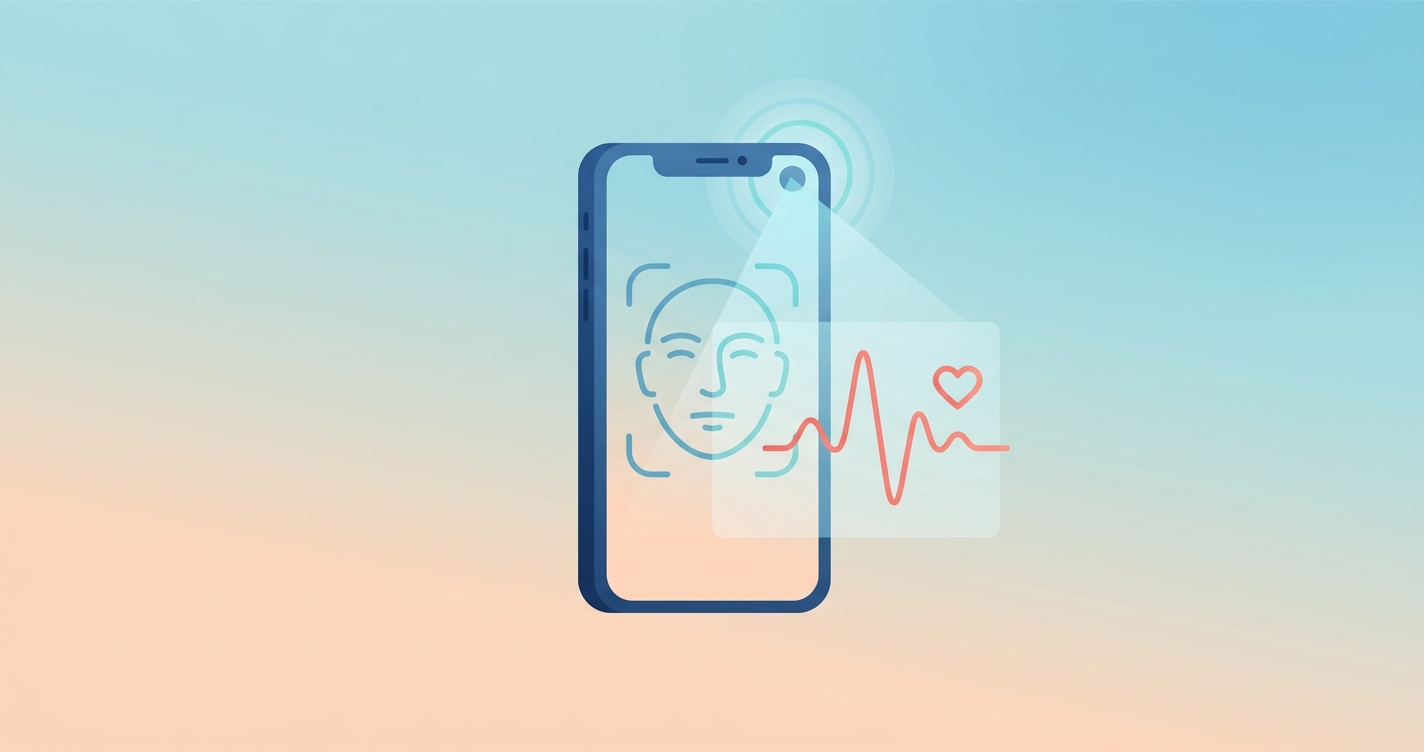
The idea that an insurance company could predict your mortality from a simple video taken on your phone sounds like science fiction. Yet, the technology to do exactly that is rapidly moving from research labs into the mainstream of digital insurance underwriting. For consumers, this raises questions about privacy and accuracy. For the insurance industry, it represents a fundamental shift in how risk is assessed. This analysis examines the technology, the evidence, and the implications of using a phone scan to predict mortality for insurance.
"The use of remote photoplethysmography (rPPG) allows for the passive, low-cost acquisition of cardiorespiratory information. The challenge for insurers is not just the collection of this data, but its interpretation and integration into existing mortality models that have been stable for decades." - Industry Analyst Report, 2023
How a 'phone scan' measures mortality risk
The core technology enabling this shift is remote photoplethysmography (rPPG). It's a contactless technique that involves using a standard camera, like the one in your smartphone or laptop, to detect subtle, imperceptible changes in the color of your skin. These changes are caused by the flow of blood pulsing through the vessels just beneath the surface. As your heart pumps, the volume of blood in these vessels fluctuates, which in turn affects how light is reflected back to the camera.
A typical process involves these steps:
- Data Capture: A user records a short video of their face (usually 30-60 seconds) in a well-lit environment.
- Signal Extraction: The software analyzes the video feed, isolating the facial region and tracking pixel data over time. It measures the minute variations in red, green, and blue light channels to create a raw rPPG signal.
- Signal Processing: This raw signal is then cleaned to filter out noise caused by movement, lighting changes, and other artifacts. Advanced algorithms then amplify the underlying physiological waveform.
- Vital Sign Calculation: From this processed waveform, key vital signs are calculated, including heart rate, heart rate variability (HRV), respiratory rate, and sometimes blood pressure and oxygen saturation.
- Mortality Risk Modeling: The extracted vital signs are fed into a predictive model. This model, often powered by machine learning, has been trained on vast datasets of vitals and corresponding mortality outcomes to find correlations that predict long-term health risk. The output isn't a "date of death," but a risk score that helps an underwriter classify an applicant.
The key is that an insurance predict mortality phone scan isn't just looking at one number. It's the combination of multiple data points, particularly Heart Rate Variability (HRV), that provides a detailed snapshot of an individual's cardiovascular and autonomic nervous system health, two powerful predictors of longevity.
Comparison: phone scan vs. traditional insurance health checks
| Feature | Phone Scan (rPPG) | Traditional Paramedical Exam | | :--- | :--- | :--- | | Method | 30-60 second video of the face | In-person visit with a medical professional | | Data Collected | Heart Rate, HRV, Respiratory Rate, Blood Pressure (estimated) | Blood/urine samples, EKG, manual vitals | | Process Friction | Low - can be done from anywhere | High - requires scheduling and physical presence | | Cost Per Applicant | Low - purely software-based | High - involves labor and lab processing | | Time to Results | Seconds | Days or weeks | | Objectivity | High - algorithmically measured | Moderate - can have inter-examiner variability | | Data Immutability| High - the scan can be re-run to verify | Low - samples are consumed during testing |
Industry Applications
For insurtech CTOs, underwriting system vendors, and BPO providers, the application of rPPG technology extends beyond simple risk scoring.
### automated underwriting flows
By integrating a phone scan into the application process, insurers can create fully automated, straight-through processing for a larger segment of applicants. Low-risk individuals can be approved in minutes, while higher-risk cases are automatically flagged for human review, dramatically reducing the cost and time of manual underwriting.
### dynamic re-evaluation
For certain types of policies, rPPG could allow for periodic re-evaluation of risk. For example, a policyholder might be incentivized to provide an annual "health scan" in exchange for a lower premium, creating a more dynamic relationship between insurer and insured.
### continuous risk assessment
A significant emerging application is in the area of continuous or "living" underwriting. Instead of a one-time snapshot, some models propose using periodic, voluntary scans to adjust premiums or offer wellness bonuses. This moves the insurance model from a static prediction at issuance to an ongoing partnership in health management. This is particularly relevant for group benefits or wellness-linked insurance products.
Current research and evidence
The concept of using rPPG for health monitoring is not new; it has a deep foundation in clinical research. A 2021 study by Wang et al. published in IEEE Transactions on Biomedical Engineering demonstrated the high accuracy of camera-based heart rate monitoring compared to traditional EKG.
What is new is the application of machine learning to these signals for mortality prediction. Researchers are now moving beyond just calculating basic vitals. Studies published in outlets like the Journal of Artificial Intelligence Research and Applications explore how deep learning models can analyze the entire rPPG waveform, not just the summary statistics. These models can identify subtle patterns in the signal's shape and variability that are invisible to the human eye but correlate strongly with long-term cardiovascular health and, by extension, mortality risk.
These AI models are trained on large, anonymized datasets that include rPPG signals and long-term health outcomes. As noted by researchers from institutions like the Reinsurance Group of America (RGA) in industry reports, the goal is to build more granular and personalized risk profiles. This allows for a more precise alignment of premium to risk, especially for populations that are underserved by traditional underwriting methods.
The future of insurance risk prediction
The trajectory is clear: underwriting is becoming less about invasive tests and more about sophisticated data analysis. As consumers become more comfortable with digital health tools, the use of phone scans for insurance applications will likely become as common as filling out a form. The technology's potential to insurance predict mortality phone scan is just one aspect of a larger trend toward embedded, real-time, and data-driven insurance products.
However, the industry must also navigate significant ethical and regulatory challenges. Concerns about data privacy, algorithmic bias, and the potential for digital redlining are valid and require transparent governance. The future will likely involve a hybrid approach where technology handles the initial assessment, with human oversight and intervention remaining critical for complex and sensitive cases.
Frequently asked questions
Q: Can a 30-second video really be accurate? A: Yes, for specific physiological markers. The technology doesn't guess; it measures physical changes. Remote PPG has been validated in numerous studies to accurately measure heart rate and heart rate variability. The predictive power comes from how these validated measurements are used in actuarial models.
Q: Is this technology replacing human underwriters? A: Not entirely. It's augmenting their capabilities. The goal for most insurers is to use this technology to fast-track low-risk applicants, freeing up human experts to focus on more complex cases that require nuanced judgment.
Q: What if I have a medical condition? Will I be automatically declined? A: Not necessarily. The scan is just one data point. Underwriting decisions are typically based on a holistic view of an applicant's health and lifestyle. A phone scan might flag a case for further review, which could involve a request for more traditional medical information.
Q: How is the privacy of the video and health data handled? A: This is a critical concern. Reputable platforms process the video in real-time and do not store the video itself. They extract the vital sign data, which is then securely transmitted to the insurer's underwriting system as a data payload. Look for providers who are transparent about their data handling and comply with regulations like HIPAA and GDPR.
As this technology moves from the lab to the front lines of insurance, the focus is on seamless integration and robust validation. Companies like Circadify are at the forefront, providing the API-first infrastructure to help underwriting platforms incorporate this data responsibly. For insurtech CTOs and platform builders, understanding how to use these new data streams is no longer optional. To learn more about integrating vitals-based scoring, you can explore the API documentation and sandbox environments available for custom builds at circadify.com/custom-builds.