
How to Secure Insurance Health Data Integration
A security architecture guide to insurance health data integration: encryption, access controls, and audit trails for moving health data into underwriting.
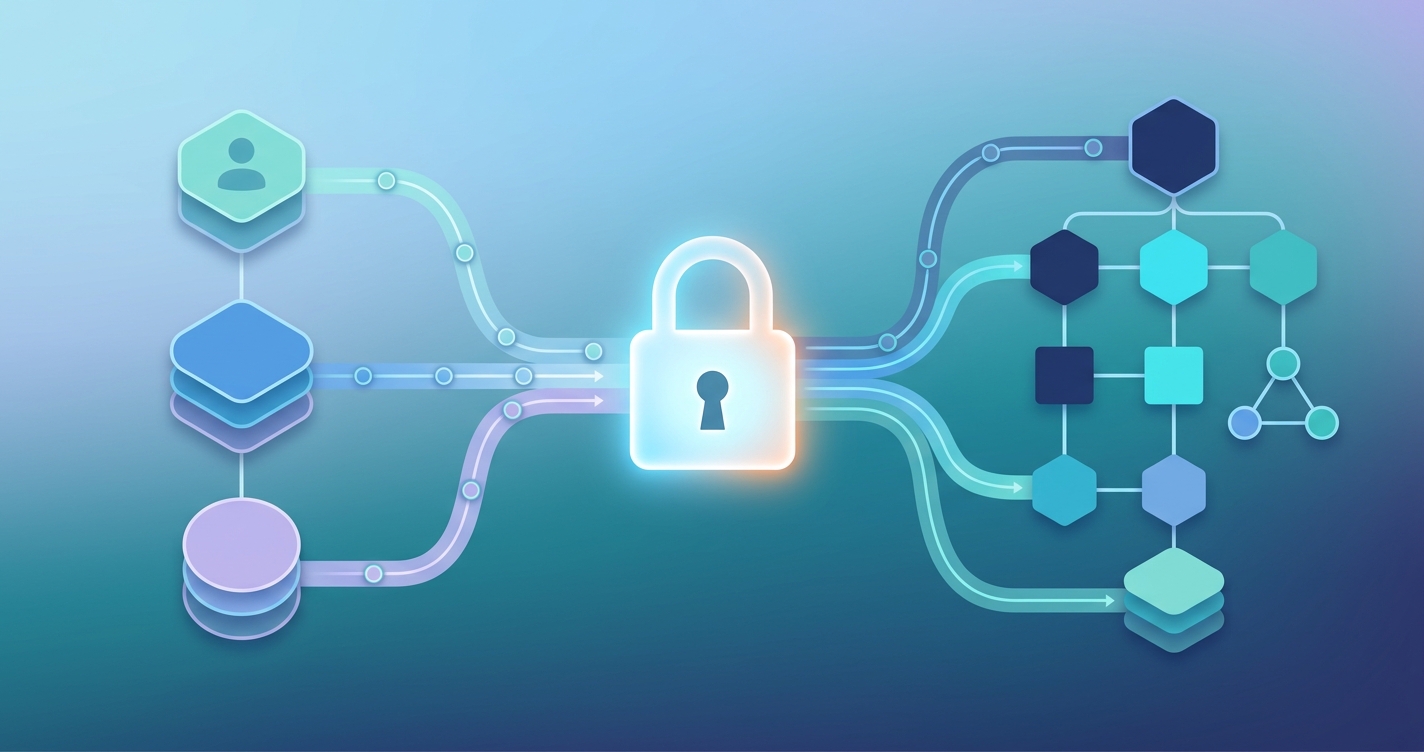
When an insurer pulls a heart rate reading, a vitals payload, or a third-party health score into an underwriting decision, that single transaction crosses more trust boundaries than most engineering teams account for. The data leaves a capture device, traverses a vendor API, lands in a decision engine, and then settles into a policy record that may live for decades. Securing insurance health data integration is not a single control you bolt on at the perimeter. It is a chain of encryption, identity, and accountability decisions that has to hold at every hop, because the weakest link defines the actual risk posture of the entire pipeline.
"The average cost of a healthcare data breach reached $9.8 million in 2024, keeping healthcare the most expensive industry for breaches for the fourteenth consecutive year.", IBM, Cost of a Data Breach Report 2024
That figure matters to underwriting platforms specifically because health data carries both regulatory weight and long retention horizons. A leaked email address is a nuisance. A leaked set of biometric vitals tied to a named applicant and a coverage decision is a regulated incident with notification obligations, contractual fallout, and reputational damage that compounds across an insurer's distribution network.
What insurance health data integration demands from security architecture
Insurance health data integration sits at an awkward intersection. The data is sensitive enough to fall under HIPAA-style protected health information rules in the United States and special-category data rules under GDPR in Europe, yet it has to move fast enough to support real-time or near-real-time underwriting decisions. You cannot treat it like batch analytics, and you cannot treat it like a low-sensitivity event stream. It needs the protection profile of clinical data with the latency profile of a transactional API.
The U.S. Department of Health and Human Services frames the HIPAA Security Rule around three categories of safeguards: administrative, physical, and technical. For a digital underwriting pipeline, the technical safeguards translate directly into three engineering pillars: encryption everywhere, least-privilege access control, and tamper-evident audit trails. The other two categories govern who is accountable and how the infrastructure itself is hardened.
A useful way to reason about it is to separate the data states. Health data is always in one of three states, and each demands a different control set.
| Data State | Primary Threat | Core Control | Common Failure Mode | | --- | --- | --- | --- | | In transit | Interception, man-in-the-middle | TLS 1.3, mutual TLS between services | Expired or unpinned certificates, downgrade to weak ciphers | | At rest | Storage compromise, stolen backups | AES-256, envelope encryption with managed keys | Encryption keys stored beside the data they protect | | In use | Memory scraping, over-broad access | Tokenization, field-level encryption, scoped access | Full PII loaded into logs, caches, or debug traces |
The "in use" row is where most underwriting integrations quietly fail. Engineers encrypt the wire and the database, then dump a full request payload into an application log during a debugging sprint and forget to remove it. Health data security in underwriting lives or dies on these unglamorous details.
Building the encrypted health data pipeline
An encrypted health data pipeline is more than TLS plus disk encryption. The goal is to ensure that no single compromised component exposes readable PII.
- Use mutual TLS between internal services, not just at the public edge, so a foothold inside the network does not grant plaintext access to data in transit.
- Apply envelope encryption: encrypt data with a data key, encrypt the data key with a master key held in a dedicated key management service or hardware security module.
- Rotate keys on a defined schedule and after any personnel change with key access, and never check keys into source control or container images.
- Tokenize or pseudonymize direct identifiers early, so downstream systems that only need a risk score never receive the underlying name, date of birth, or contact details.
- Strip PII from logs, metrics, traces, and error reports by default, and treat any exception as a reportable defect.
The architectural principle underneath all of this is data minimization. The most secure health field is the one your downstream service never receives. If a decision engine only needs a normalized risk score and a small set of derived features, the integration should not be shipping raw vitals and full applicant identity to it.
Access controls and PII protection for insurance workflows
PII protection in insurance comes down to a simple question asked continuously: who can see what, under which conditions, and for how long. Role-based access control is the baseline, but mature pipelines layer attribute-based and just-in-time access on top.
- Define roles around job function, not convenience, so an underwriter, a data scientist, and a support agent each see a different projection of the same record.
- Enforce least privilege by default and require explicit, time-boxed elevation for any access to raw health fields.
- Separate duties so the people who can read production health data cannot also alter the audit logs that record their access.
- Apply network segmentation so the underwriting data store is not reachable from general corporate systems.
The IBM 2024 report noted that breaches involving stolen credentials took an average of 292 days to identify and contain, the longest of any attack vector. That single statistic is the strongest argument for aggressive identity controls. If a credential is the master key, then short-lived credentials, multi-factor enforcement, and continuous monitoring are not optional hardening, they are the core defense.
Industry Applications
Insurtech platforms and real-time scoring apis
For platforms exposing a scoring API, the security boundary is the API contract itself. Strong client authentication, scoped API keys or OAuth tokens, request signing, and strict input validation prevent the API from becoming an exfiltration channel. Returning a score and a reason code rather than echoing back raw health inputs keeps the blast radius small.
Underwriting system vendors
Vendors integrating health data into policy administration carry the burden of legacy systems that were never designed for special-category data. Here the practical pattern is a secure ingestion layer that encrypts and tokenizes on arrival, so the older system downstream stores references and scores rather than raw PII.
Bpo and outsourced processing providers
When processing crosses organizational boundaries, contractual controls matter as much as technical ones. Business associate agreements, documented data processing terms, and the ability to produce audit trails on demand become procurement requirements, not afterthoughts.
Current research and evidence
The evidence base points consistently toward two levers. First, encryption and identity management remain the highest-yield controls. The IBM Cost of a Data Breach Report 2024 found that organizations making extensive use of security automation and AI reduced breach costs by an average of $2.2 million and shortened breach lifecycles by roughly 100 days compared with those that did not. The same research flagged that a shortage of skilled security staff added an estimated $1.76 million to breach costs, which is why automated, policy-driven controls outperform manual review at scale.
Second, regulatory guidance has converged on a defense-in-depth model. The HHS guidance on protecting sensitive health information and the NIST Cybersecurity Framework both emphasize layered safeguards, continuous risk assessment, and the principle that no single control should be load-bearing. NIST's broader move toward zero-trust architecture reinforces the same idea for data integration: verify every request, assume the network is hostile, and grant the minimum access required for each transaction.
For underwriting specifically, de-identification and privacy-enhancing techniques are increasingly relevant. When health signals can be transformed into risk features without retaining raw identifiers, the regulatory and breach exposure of the pipeline drops substantially while the analytic value is preserved.
The future of insurance health data integration
Three shifts are reshaping how secure integrations get built. The first is the normalization of zero-trust architecture, where service-to-service calls are authenticated and authorized individually rather than trusted because they originate inside a network perimeter. The second is the growth of privacy-enhancing computation, including tokenization at the edge and techniques that let a model score data without the scoring service ever holding plaintext PII. The third is regulatory tightening, with data protection authorities scrutinizing automated decision-making and special-category data more closely, which raises the bar on auditability.
The common thread is that auditability is becoming a first-class design requirement rather than a compliance checkbox. Tamper-evident, append-only audit trails that record every access, transformation, and decision will increasingly be the difference between a defensible pipeline and an indefensible one. Teams that design for the audit from day one will move faster when regulators, partners, and security reviewers come asking.
Frequently asked questions
What is the most overlooked control in insurance health data integration?
Logging and telemetry. Teams routinely encrypt the wire and the database, then leak full health payloads into application logs, traces, and error reports. Treat logs as a regulated data store and strip PII by default, because attackers and accidental exposures both find logs first.
How should encryption keys be managed in an underwriting pipeline?
Keys should live in a dedicated key management service or hardware security module, never beside the data they protect and never in source control or container images. Use envelope encryption, rotate keys on a schedule and after personnel changes, and separate key-management duties from data-access duties.
Why are audit trails so important for health data security in underwriting?
Audit trails answer the questions every regulator and partner eventually asks: who accessed this record, when, and what decision resulted. Append-only, tamper-evident logs let you prove proper handling, detect anomalous access early, and meet notification obligations with evidence rather than guesswork.
Can you reduce risk by minimizing the health data you integrate?
Yes, and it is the single most effective strategy. Data minimization and tokenization mean downstream systems receive only the derived risk score and features they actually need, not raw vitals and identity. The field you never transmit cannot be breached.
Circadify is addressing this space directly, building real-time vitals-based risk scoring with security architecture treated as a primary design constraint rather than an afterthought. Insurtech CTOs evaluating how to move health data into underwriting workflows safely can review the API documentation and test integration patterns in a sandbox at circadify.com/custom-builds.